

A Summer in Milos: Life on a Greek Island

At the end of April, after several months in northern Norway, it is time for a complete change of scenery. I trade the still snow-covered mountains of the Lofoten Islands, drysuits and sub-zero temperatures for a small island in the Cyclades, right in the middle of the Aegean Sea: Milos.
When I arrive, I still know very little about the island. A few images of whitewashed villages, strangely shaped cliffs and turquoise waters, without really knowing what lies beyond the postcard. Spending several months here will give me the chance to experience life in Milos beyond what you normally see during a short holiday.
From May to October, Milos becomes both my workplace and my everyday life. Between days spent out at sea and exploring on my days off, I gradually get to know its coastline, volcanic landscapes and villages, while discovering what it really means to live and work on a Greek island for an entire season.
Contents
Arriving in Milos
The ferry from Athens pulls into Adamas in the middle of the night. I step off with my bags, still a little dazed from the journey. Under the harbour lights, I can just make out a few whitewashed buildings, fishing boats along the waterfront and the dark outline of the hills behind them. Everything else will have to wait until morning. After months surrounded by the green valleys and snow-covered mountains of northern Norway, I have no real idea what to expect from my new home.
The next morning, the first thing that strikes me is just how dry Milos is. There are hardly any trees, the vegetation is low and the hills are almost bare beneath the sun. I head out to explore Adamas on foot. It’s late April, and the streets are still quiet, the beaches a long way from their summer crowds. But the island is already starting to wake up. Some places have only just reopened, while elsewhere roads are being repaired and terraces are being prepared for the season ahead. Milos doesn’t feel quite ready for summer yet, but you can sense it coming.

I also start getting used to the small routines of everyday life. To buy groceries, I walk down to the little supermarkets in Adamas. Sometimes I wander through the aisles only to find that what I came for simply isn’t there because the supply boat hasn’t arrived yet. It’s through little details like these that I slowly begin to understand the rhythm of island life.
As the days go by, I discover a Milos that looks quite different from the Cyclades I had pictured in my head. The whitewashed houses and narrow streets are there, of course, along with the kind of Aegean blue that makes you want to jump straight into the water. But as soon as I leave Adamas behind, the landscape seems to change around every corner. Within just a few kilometres, brilliant white rock gives way to shades of red, yellow and ochre. Steep cliffs alternate with long stretches of beach, and parts of the coastline look as though they belong on another planet.
I’ll soon learn that much of this extraordinary variety can be traced back to Milos’ volcanic past. For now, though, I have more immediate things to figure out: finding my feet, meeting the team and getting to know what will be my office for the next few months — the island’s coastline and the sea around it.
Working as a Sea Kayak Guide in Milos
The scenery may be completely different from the Lofoten Islands, but my working days still feel surprisingly familiar: a paddle in my hands and most of my time spent out on the water. For the season, I’m working as a sea kayak guide, mainly leading day trips along different parts of the Milos coastline.

My days usually start with getting the kayaks and gear ready before welcoming the group and going over the basics of paddling and safety. Once we’re on the water, we spend several hours following the coastline, stopping along the way for a swim, some snorkelling or simply to enjoy a beach best reached from the sea. No two days are exactly the same, though. Routes depend on the conditions, and in Milos, the wind often has the final say.
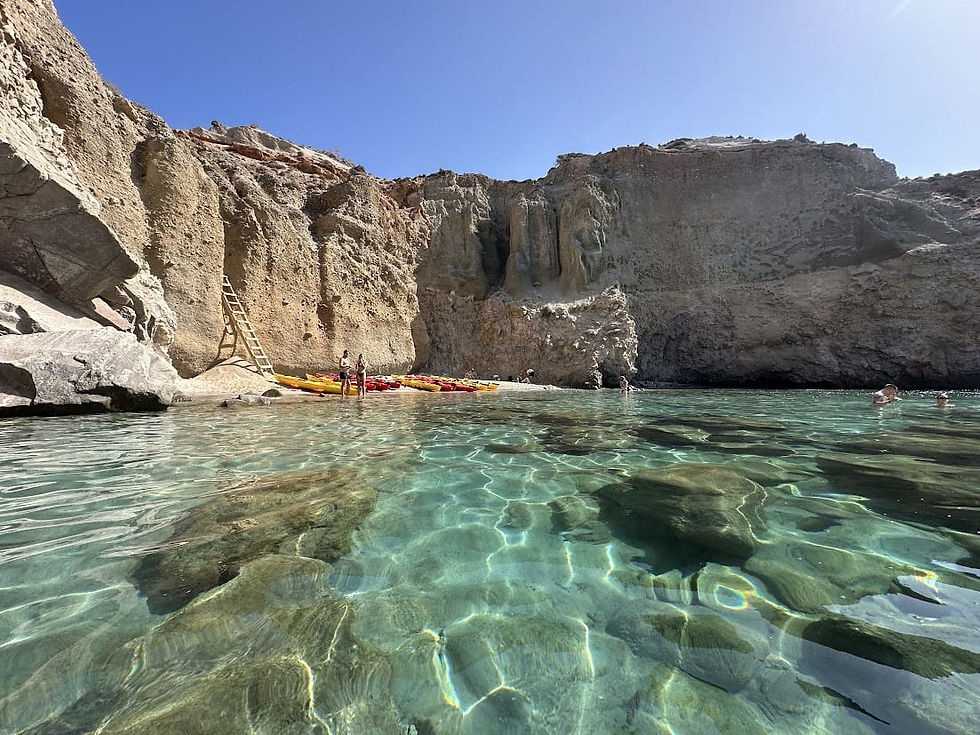
But guiding a kayak trip is about much more than simply getting a group from A to B. It also means learning how to bring the places we paddle through to life. As the weeks go by, I get to know Milos while learning how to share its stories with others — its history, fishing villages, old mines and landscapes, but above all its remarkable geology, which quickly becomes one of the recurring themes of my tours.
From the water, Milos reveals a completely different side of itself. We paddle beneath cliffs that shift from brilliant white to shades of red, yellow and orange, slip into sea caves and weave past rock formations sculpted into the most unexpected shapes. Some days, my “office” feels more like a film set than a place of work.

Milos, an Island Shaped by Volcanoes
It doesn’t take long to realise that there is much more to Milos than meets the eye. From the white cliffs of Sarakiniko to the colourful rocks of Paliochori and the hot springs bubbling up through the sand and beneath the sea, traces of the island’s volcanic past are everywhere.
Milos is part of the Hellenic Volcanic Arc, which stretches across the southern Aegean and also includes islands such as Santorini and Nisyros. The landscapes we see today are the result of millions of years of volcanic and hydrothermal activity, later shaped by erosion, wind and the sea. This complex geological history is behind much of the extraordinary variety of colours, textures and rock formations found across the island.
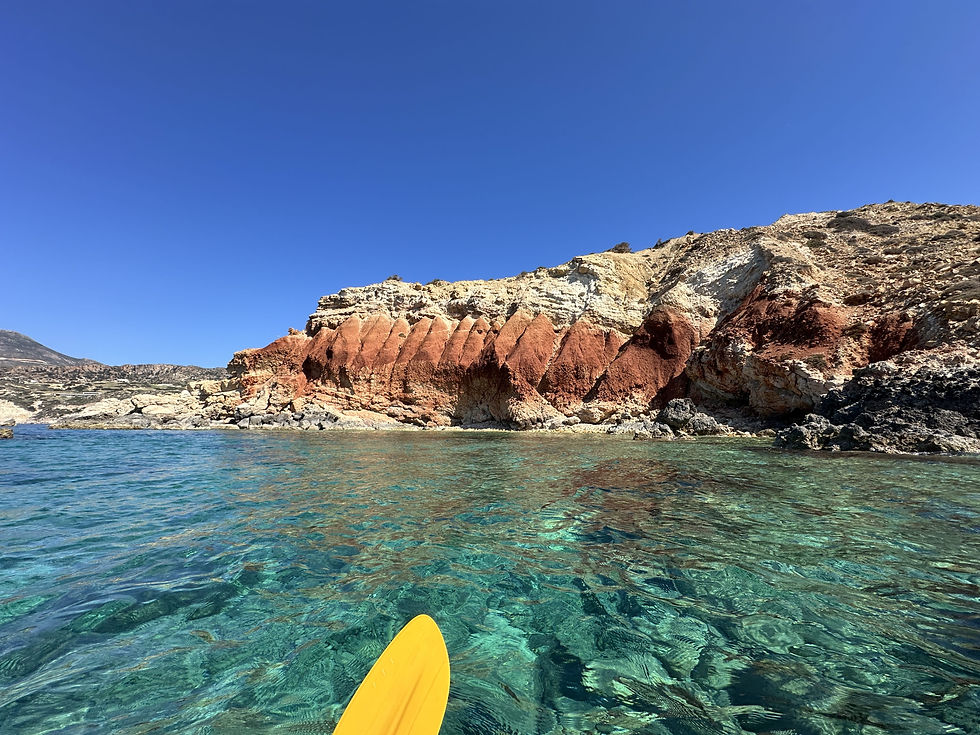
And this geological richness goes far beyond the scenery. Milos has been valued for its mineral resources for thousands of years. As far back as prehistoric times, obsidian — a black volcanic glass with an exceptionally sharp edge — was quarried here and traded throughout much of the Aegean. Mining remains an important part of the island today, particularly for minerals such as bentonite and perlite.
After several months of life in Milos, I find myself looking at the landscapes I paddle past almost every day in a completely different way. A cliff is no longer simply white, red or yellow: its colours reveal something about the island’s history. And from a kayak, sometimes just a few metres from the rock face, that geology is impossible to ignore.
Exploring Milos from the Sea
After several weeks spent paddling along the coastline almost every day, one thing becomes clear: Milos is an island made to be explored from the water. Its coastline is home to more than 70 beaches, along with cliffs, sea caves, natural arches and small coves shaped by its volcanic past, the wind and the waves.
From a kayak, the landscape takes on a whole new dimension. We move slowly enough to notice the colours and layers in the cliffs, slip inside sea caves and reach small beaches we might otherwise never have stopped at. It’s a completely different way of experiencing the island — closer, slower and always at sea level.
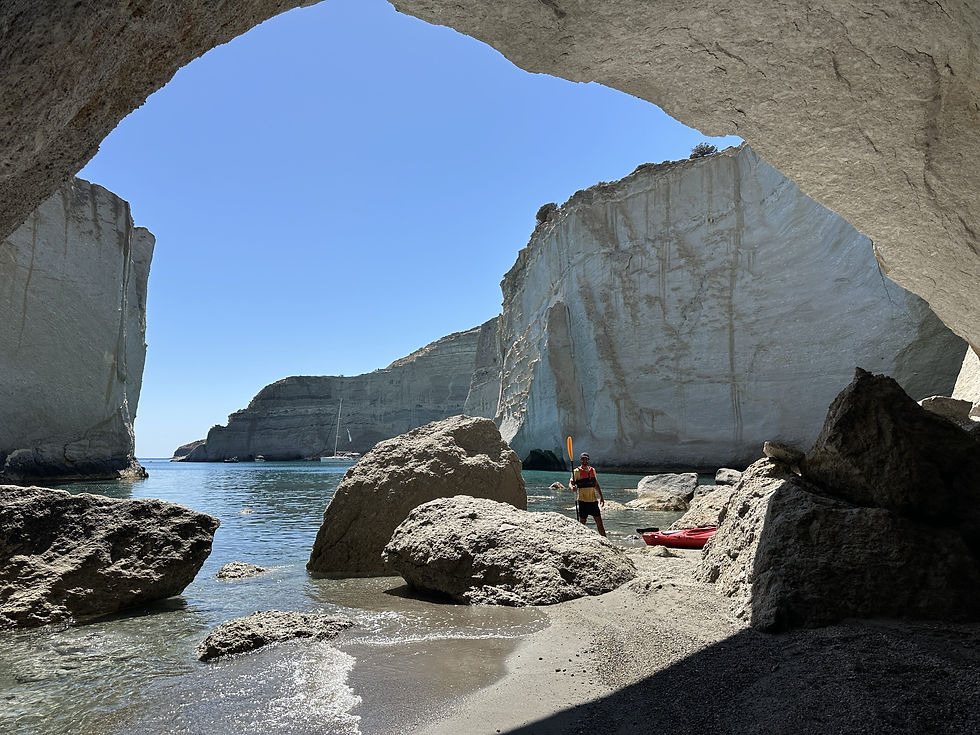

The south coast is where I spend most of my time on the water. Around Tsigrado and Gerakas, towering volcanic cliffs drop straight into incredibly clear water. Further west, the scenery becomes even more dramatic as you approach Kleftiko, probably one of the most iconic places in Milos. There is no real beach here in the traditional sense. Instead, huge white rock formations rise out of the sea, carved with arches, narrow passages and caves waiting to be explored.

Not far from Kleftiko lies Sykia, a huge sea cave where part of the roof has collapsed, allowing sunlight to pour in from above. Places like this are best experienced from the water: rather than simply looking at the landscape from a distance, you find yourself paddling right through it.


That is probably what I love most about kayaking in Milos. It is not always about getting somewhere as quickly as possible. We follow the coastline, paddle into a cave that catches our eye, stop for a swim and take the time to notice everything that lies between the island’s better-known spots. And sometimes, it is those nameless stretches of coastline that end up becoming my favourites.
The Meltem: What to Know Before Visiting Milos
If there is one thing I quickly learn from working on the water in Milos, it is to keep an eye on the wind. Every day. Often several times a day.
During the summer, the Meltem, the northerly wind that regularly blows across the Aegean, can last for several days and completely change the conditions around the island. For me, that sometimes means moving the starting point of a tour, heading to a more sheltered part of the coast or changing the day’s plan altogether.
It is something worth keeping in mind when visiting Milos too. A windy day does not necessarily mean giving up on the beach or a day on the water: conditions can be completely different from one side of the island to another. When the north coast is exposed to strong winds and waves, parts of the south coast can be much calmer — and depending on the wind direction, the opposite can also be true.
That is why I would avoid planning every day of a trip to Milos too rigidly. If there is a particular boat trip, kayak tour or beach you really want to experience, leave yourself some flexibility. Sometimes, the weather will make the decision for you.
And then there are the days when the wind almost disappears. The sea turns glassy, the cliffs reflect on the surface and it is hard to imagine that the exact same stretch of coastline looked completely different just a few days earlier. After several months here, I think it is partly these contrasts that make me appreciate the Aegean so much.
Milos in May, July or September: When Should You Visit?
Spending the season in Milos, from late spring into early autumn, also gives me the chance to see just how much the island changes from one month to the next.
In May, Milos is slowly waking up. Some places have only just reopened, the beaches are still relatively quiet and the temperatures are pleasant. Everything feels a little more spacious and the pace is slower. For exploring the island without the peak-season crowds, it is a time of year I particularly enjoy.
Then July and August arrive, and the atmosphere changes completely. Ferries bring new visitors every day, scooters and ATVs fill the roads, and the island’s best-known spots can quickly become busy. Sarakiniko, Plaka and the most popular beaches inevitably feel very different from the way they did in spring.
It is also the busiest part of the season for me. Kayak trips follow one after another and, while most people come to Milos to slow down, seasonal life tends to work the other way around.
By September, things gradually begin to find a different balance. The island is still lively and the sea holds onto the warmth of summer, but the crowds slowly start to thin out. After the intensity of the previous weeks, a sense of calm begins to return.
If I were choosing when to visit Milos purely to explore the island, I would personally favour the months on either side of peak season. Milos is still very much alive, but without quite the same crowds as July and August.
The Places I Grew to Love in Milos
After several months on the island, the places I love most do not necessarily match a list of Milos’ most famous sights.
There is, of course, Sarakiniko, a place you seem to see everywhere before you even set foot on the island. Its white volcanic rock, sculpted by erosion, forms one of the most recognisable landscapes in Milos. But it is also a place that feels completely different depending on when you visit. Early in the morning, or later as the crowds begin to disappear, I find myself appreciating it all over again.


Then there are the small coastal villages, especially Mandrakia and Firopotamos, with their colourful boat garages built right at the water’s edge. I love these places because they are a reminder that, long before Milos became one of the most photographed islands in the Cyclades, it was — and still is — an island shaped by fishermen and life at sea.


And then there is Plaka, especially towards the end of the day. Its whitewashed streets come alive in the evening, and a short walk above the village opens up to sweeping views across the Aegean Sea.

The Side of Milos You Don’t See on a One-Week Holiday
When you first arrive in Milos, it is naturally the beaches and dramatic landscapes that get most of your attention. But after spending several months here, I gradually discover an island that is far more complex than the postcard version most visitors take home with them.
Mining is probably the most visible example. In some parts of the island, it takes only a short drive to go from turquoise beaches to vast open quarries. It can feel surprising in a destination now so closely associated with tourism, yet mining has been part of Milos’ history for thousands of years and remains very much present in its landscape today. There is even a museum in Adamas dedicated to the island’s mining heritage.
Then there are the fishing villages, boats returning to the harbour, octopuses hanging in the sun to dry, and all the small routines of everyday life carrying on behind the restaurant terraces and beaches.
And then there is the seasonality of island life. During summer, much of Milos moves to the rhythm of its visitors. Restaurants, tours, accommodation and activities are running at full speed, and many people, like me, come here to work for just a few months. Behind someone’s summer holiday is someone else’s busiest season of the year.
It is an interesting reality to experience from the other side. The places where I spend my working days are the same ones some travellers have waited all year to see. What feels extraordinary to them gradually becomes normal to me — until I suddenly catch myself heading to work alongside turquoise water and volcanic cliffs and remember just how unusual my everyday life actually is.
Six Months of Life in Milos: What I’ll Take Away
When I arrived at the end of April, Milos was first and foremost my next place of work. A few months later, the island feels much harder to sum up.
Of course, I’ll remember the hours spent on the water, the caves, the colourful cliffs and those days when the Aegean seemed almost perfectly still. But I’ll also remember the wind forcing us to change our plans, the intensity of the summer months, driving the same roads over and over again, the places that slowly became part of my routine, and all those little details you only begin to notice when you stay somewhere long enough.
More than anything, these months of life in Milos have allowed me to experience the island at a completely different pace from a short trip. After paddling past the same cliffs, returning to the same beaches and watching the island change from spring into autumn, the landscape begins to tell a story that goes far beyond the postcard.
And perhaps that is what I enjoy most about spending a season working in one place: having enough time to move beyond that first impression. Arriving as a stranger, slowly learning to understand the landscape and its rhythms, and eventually leaving with the feeling that, at least for a little while, I got to know what lies behind the images that first brought me here.


Comments