

The Huayhuash Trek : 8 Days in the Peruvian Andes

A legendary route through one of the world’s most beautiful mountain ranges, among dizzying peaks, turquoise glacial lakes and Andean culture. This is the complete story of my eight days on the Huayhuash Circuit from Huaraz, along with all the practical advice you need to prepare for this unique adventure.
Contents
About the Huayhuash Circuit
My eight-day journey on the Huayhuash trek
Day 1: First steps at altitude and an encounter with the giants
Day 2: Carhuacocha, mirror of the peaks
Day 3: Hanging lagoons and a dizzying mountain pass
Day 4: Trapecio and San Antonio—the vertical challenge
Day 5: A long descent towards civilisation
Day 6: An endless climb towards the sky
Day 7: A panoramic ridge and an emerald lake
Day 8: Final steps in the mountains
A walk back to what matters
My advice for preparing for the Huayhuash trek
With or without a guide?
The agency I travelled with
Price and what was included
Complete packing list
Best time to do the trek
Fitness and acclimatisation
About the Huayhuash Circuit
I had already been travelling through the Peruvian mountains for several months, moving from sacred valleys to sacred summits. After visiting Cusco and the unmissable Machu Picchu, another silhouette was calling me—wilder and more secretive: the Cordillera Huayhuash. I had heard it described as a hidden gem, one of the most spectacular treks in the world, far from the crowds and reserved for those willing to face the effort and altitude.
This isolated Andean range lies south of the Cordillera Blanca and traces a jagged line across central Peru. Over a 110-kilometre loop, the trail crosses dizzying passes above 5,000 metres, skirts milky glacial lakes and reveals almost unreal panoramas around every corner. Giants rise here: Yerupajá at 6,617 metres, Peru’s second-highest mountain, and Siula Grande, made famous by the dramatic story Touching the Void.
This is not simply a hike. It is a physical and mental commitment, an immersion at high altitude and a journey that tests your breath, your legs and your determination. It is intended for experienced hikers who know the solitude of wide-open spaces and understand how to listen to their bodies. Acclimatisation is not only recommended—it is vital. But for those who are ready, the experience is unforgettable.
My eight-day journey on the Huayhuash trek
Day 1: First steps at altitude and an encounter with the giants
Stage: Matacancha (4,170 m)–Mitucocha (4,270 m)
Distance: 8 km | Elevation gain: 530 m | Elevation loss: 500 m | Duration: 4 hours
The day before leaving, I am told that we will set off at four in the morning. My alarm rings inside the still-silent hostel in Huaraz. Bag packed, I meet Margarita, our Quechua guide. In her forties, she has lively eyes and a warm smile, but her stride is already purposeful. Dawn has not yet broken when we climb into the minibus, still empty but loaded with tents, cooking pots, gas bottles and our precious food supplies. The drive around town begins.
One by one, the other members of the group climb aboard, wrapped in their fleeces. Seven nationalities and seven personalities, brought together by the desire to walk.
Conversation soon begins to flow. We talk about previous treks, expectations, boots and sleeping bags. Five hours later, after dusty tracks and relentless bumps, we reach Matacancha, the trailhead perched at 4,170 metres.
Two men are waiting for us: Marco, our quietly smiling cook, and Alex, the muleteer. The air is crisp and cool, while the sunlight already bites into the surrounding summits. Faces tighten with effort from the first few steps; at this altitude, every climb feels magnified. But the excitement of finally setting foot on the legendary Huayhuash trails carries us forward.
Before long, the first snow-covered giants rise ahead of us: Ninashanca and Rondoy, brilliant white beneath a flawless blue sky. Their beauty feels almost unreal, as sharp as a blade cutting through the azure.
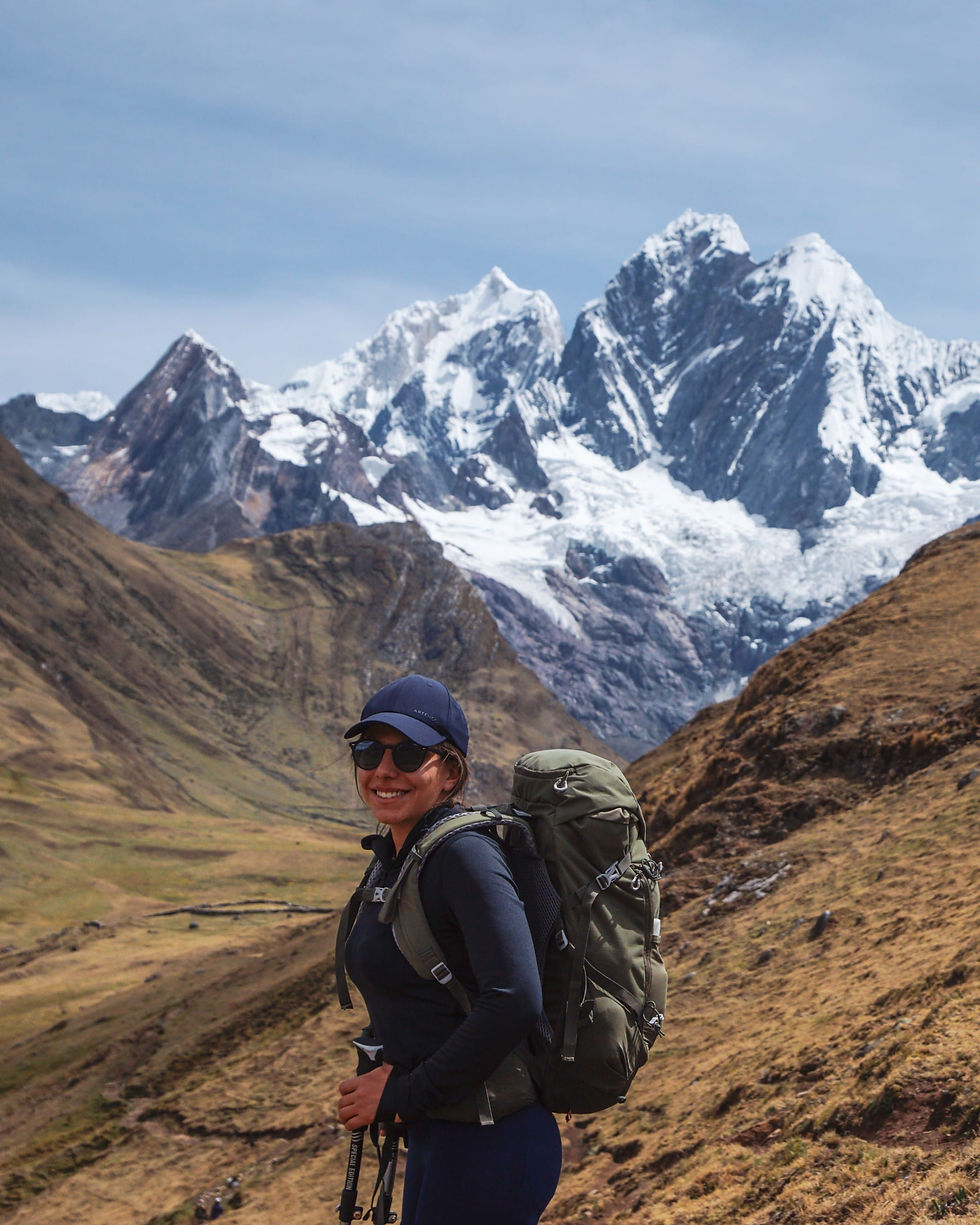
We stop at the day’s mountain pass to enjoy the sandwiches Marco has prepared. Silence reigns, broken only by the whistle of the wind and the group murmuring at the view. The terrain softens during the descent, tall grasses dance in the breeze and free-roaming horses graze peacefully in the distance.
At 2 p.m., we reach the Mitucocha campsite beside a glacial lake surrounded by moraines. The afternoon passes slowly. Some people swim in the crystal-clear water despite the cold, while others lie in the sun with their eyes closed. Tea and biscuits are served in the mess tent at four, followed by a hot dinner at six as stars begin to fill the sky.
Day 2: Carhuacocha, mirror of the peaks
Stage: Mitucocha (3,900 m)–Carhuac Pass (4,650 m)–Carhuacocha (4,138 m)
Distance: 11 km | Elevation gain: 620 m | Elevation loss: 600 m | Duration: 6 hours
Frost crackles beneath my fingers as I unzip the tent. The fabric is white with ice, frozen stiff during the night. I poke my head outside and stop in amazement: the first rays of sunlight are setting the snowy peaks opposite our camp ablaze. Their reflections in the lake create a palette of gold, pale blue and pastel pink. I immediately forget the cold awakening.

At six, we share a hot breakfast in the communal tent. By seven, backpacks on, we leave Mitucocha at a slow pace. The trail climbs gently through a valley carpeted with clumps of ichu, the coarse Andean grass rippling in the wind. Around us, the silence of the mountains feels almost solemn.
We climb steadily towards Carhuac Pass, each of us focused on our breathing. Our breath is short and our muscles ache, but the landscape makes us forget the fatigue. Once over the pass, the panorama unfolds like a reward: nestled among the peaks lies the milky-green Lake Carhuacocha, reflecting the surrounding glaciers.

We descend through flower-filled pastures to the lakeshore, where Alex has already set up camp. The afternoon is warm and bright. We wash in the icy water, dry our belongings on sun-warmed rocks, read, write and play cards. A simple luxury, far from everything.

Day 3: Hanging lagoons and a dizzying mountain pass
Stage: Carhuacocha (4,138 m)–Siula Pass (4,850 m)–Huayhuash (4,330 m)
Distance: 13 km | Elevation gain: 630 m | Elevation loss: 500 m | Duration: 6 hours
As it does every morning, the alarm rings at six. Sounds are muffled in the still air of the camp: sleeping bags rustling, Marco’s cooking pots clinking and the wind breathing against the tent fabric. We leave early to make the most of the morning light—the light that transforms the mountains.
The trail climbs from the very first steps, following Lake Carhuacocha as it slowly recedes behind us. We soon enter a hanging valley containing three glacial lagoons whose colours shift between emerald, turquoise and milky blue. Each seems brighter than the last, as if holding light between its shores.
When we reach Mirador de las Tres Lagunas, the group stops in silence. The view is spectacular: the three lakes unfold one after another beneath us, framed by the steep summits of Yerupajá, Jirishanca and Siula Grande. Behind them, glaciers gleam like shells of glass.
As we continue towards the pass, I find myself walking alone beside Margarita for a while. She does not speak much, but I have noticed that she always talks to Marco and Alex in Quechua. I ask her a simple question. “Are you from here?” She smiles without breaking stride. “Yes, from Huayllapa, where we’ll sleep the day after tomorrow. Quechua is my first language. I learnt it long before Spanish.”

She explains that Quechua is still very much alive in the mountain communities and that younger generations are only now becoming bilingual through school. She tells me about her grandmother, who raised llamas in the highlands, and about a childhood spent walking through these valleys. Her voice is gentle and deeply rooted. These are her mountains. Walking beside her is not simply a matter of following a guide—it is like following the living memory of the range.
Reaching Siula Pass at 4,850 metres demands one final effort. At the top, the beauty of the panorama sweeps every trace of fatigue away. We stay there for a long time, looking towards the mountains as though they might speak to us.

The descent to the Huayhuash campsite is gentle. When we arrive, an elderly man emerges from a hut and offers us… cold beers. It is an absurd meeting of two worlds, one rustic and wild, the other almost touristy. We laugh, raise our bottles and savour the unexpected reward.
That evening, the sky is perfectly clear. Stars cling to the ridges like fireflies. I fall asleep thinking about Quechua, about the women of the mountains and about a language I cannot understand but which the mountains themselves seem to whisper.

Day 4: Trapecio and San Antonio—the vertical challenge
Stage: Huayhuash (4,330 m)–Trapecio Pass (5,000 m)–Quebrada Guanacpatay (4,500 m)–San Antonio Pass (5,100 m)–return to Guanacpatay
Distance: 15 km (12 km + 3 km return) | Elevation gain: 1,200 m (700 m + 500 m) | Elevation loss: 500 m | Duration: 8 hours
Margarita smiles that morning. “Today, easy day!” We do not yet know that those words will remain engraved in our memories—for their irony.
From the start, the trail climbs sharply through an arid, almost lunar landscape. Low vegetation has given way to raw rock, its ochre shades contrasting with the brilliant blue sky. The ascent to Trapecio Pass at 5,000 metres is tough. Our breath is short, our muscles strain and our legs respond more slowly. Yet the view from the top is worth every drop of sweat: sharp ridges, torn valleys and fleeting shadows.
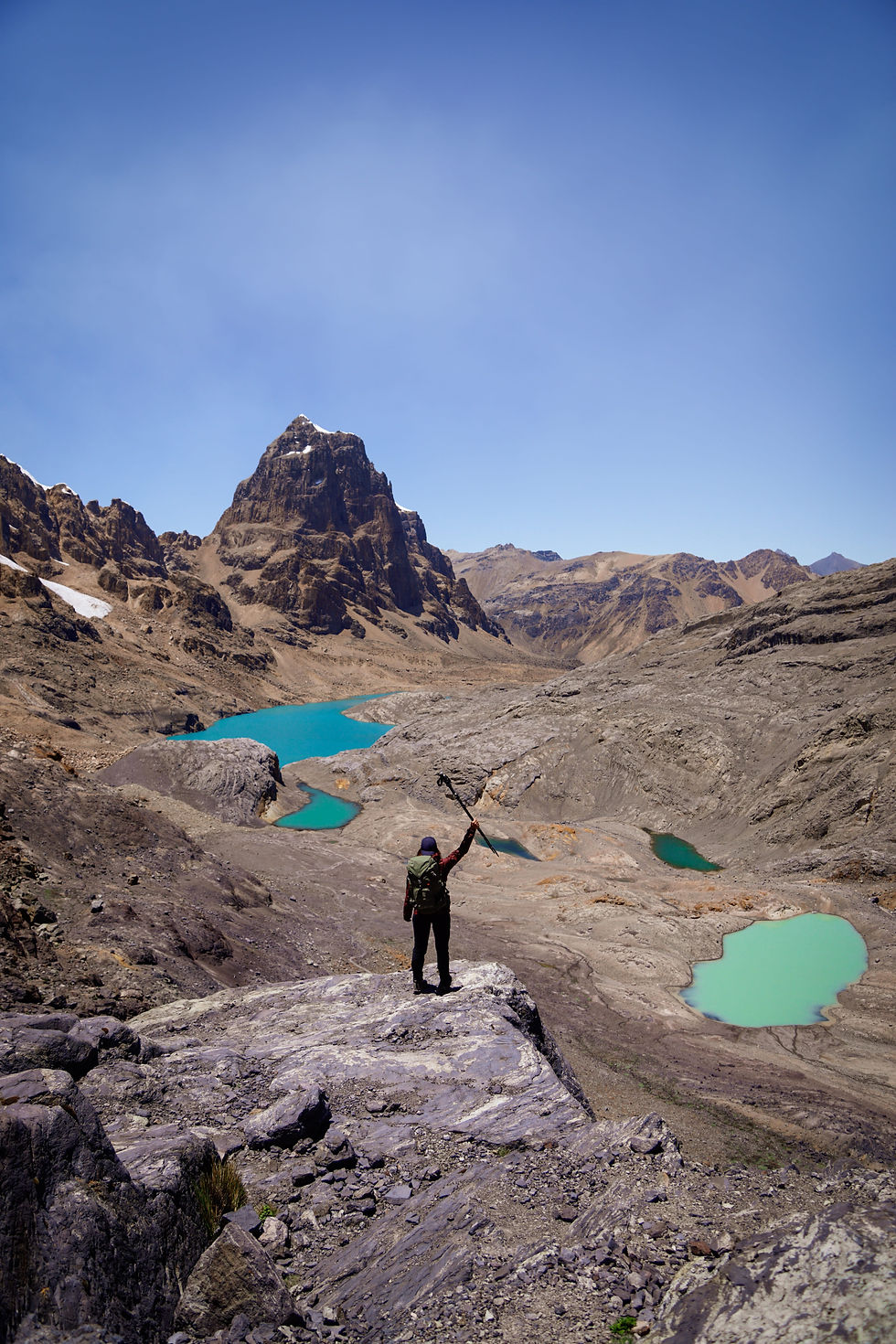
But the challenge is not over. After a quick meal at the Quebrada Guanacpatay camp, Margarita suggests an optional hike to San Antonio Pass, considered one of the trek’s finest viewpoints. I remember the words of a hiker I met in Huaraz: “You can’t miss that view.” I pick up my poles and go.
The climb is steep, almost vertical in places, and the trail is little more than a ribbon of loose gravel. We make our way upwards in short switchbacks, sometimes on all fours. But at the top, the view over the Jahuacocha valley and the Andean giants is breathtaking. I remain seated for a long time, speechless and almost stunned.

The descent? A controlled slide over rolling stones. Trekking poles are quite literally essential. At the bottom, our tents are already waiting on a windswept patch of grass.
That evening, the laughter around camp is quieter. We are completely drained. We exchange knowing looks like survivors of an invisible storm.
Day 5: A long descent towards civilisation
Stage: Quebrada Guanacpatay (4,500 m)–Huayllapa (3,500 m)
Distance: 13 km | Elevation gain: 100 m | Elevation loss: 1,100 m | Duration: 6 hours
The night was calm but bitterly cold. This morning, condensation has frozen the walls of the tent like frosted glass. I get dressed inside my sleeping bag, trying not to expose a single centimetre of skin to the freezing air.
Two group members emerge with difficulty. Their grey faces leave no doubt that something is wrong: nausea, dizziness… perhaps food poisoning, perhaps altitude sickness. One grimaces in silence and climbs onto the horse. Alex will help them descend gently to the village.
For the rest of us, the day begins with a gradual descent through a narrow valley. The wind has dropped and the silence is immense, broken only by the river we have followed from camp. Condors circle in the distance, tiny against the blue. Clumps of yellow grass, queñua bushes twisted by the elements and rocks carved by erosion mark our route.
The trail is steady but monotonous, so conversation begins again. We talk about food—always a classic—but also about our lives “down below”: work, love and the unexpected turns life takes. The group has grown close over the past few days. Often, the silences we share speak the loudest, but today words are slowly leading us back towards civilisation.
Around a bend, a waterfall appears, followed by the first houses. Huayllapa, nestled against the slope, materialises like an apparition. Children watch us from a distance. Women sort herbs into buckets. Dogs roll in the dust. Life here feels simple and hard, yet vibrant.
We pitch our tents on the football field, its grass yellowed by the wind. A few minutes away, an old guesthouse offers hot showers for ten soles. I rush there without hesitation, but fate has a sense of humour: the electricity cuts out just as I turn on the tap. A blast of icy water finishes me off. I give a hollow laugh. At least I am clean.
The same guesthouse has a small shop selling a few provisions—crisps, chocolate bars and beer. It even has Wi-Fi… when the power works. That evening, everything remains off. Somewhere inside, I feel relieved. I had almost forgotten that the connected world existed.
Dinner is livelier than on previous nights. The village lights flicker and a group of young people passes by with a crackling speaker. But another music fills our tents: rivers, wind and footsteps on stone.
Tomorrow, we will climb again. Towards other silences.
Day 6: An endless climb towards the sky
Stage: Huayllapa (3,500 m)–Tapush Pass (4,800 m)–Qashpapampa (4,500 m)
Distance: 12 km | Elevation gain: 1,200 m | Elevation loss: 200 m | Duration: 6 hours
The village is still sleeping as we pack up our tents by headtorch. The smoke from Andean families preparing breakfast hangs in the air, while a cockerel calls somewhere in the darkness. We leave the football field, and Huayllapa quickly disappears behind us. Back to the silence.
The climb begins gently, almost kindly, beside a clear mountain stream. But that gentleness is deceptive: 1,200 metres of ascent lie ahead, with no way around it.
The trail winds through a narrow valley where the morning light is slow to arrive. The damp air, struggling mules and heavy bags make every step a measured effort. Some people listen to music; others retreat into the rhythm of their breathing. I think about what Margarita told me the day before as we waited for our food.
“I come from the community of Llamac. When I was a child, I used to climb with my parents to sell cheese at the market in Huaraz. Today, I guide foreigners here, through the mountains I once walked barefoot.”
Her words stay with me all day. They give every step greater depth and a sense of connection. This is no longer merely a trek, but living land, passed down and walked across for generations.
Around midday, we reach Tapush Pass, a wide, bare saddle swept by dry wind. The landscape opens again. The peaks recede, and the mountain range seems to close behind us like a door being gently shut. It is not the trek’s most spectacular pass, but it is where I most strongly feel that I have crossed a threshold and begun moving towards the end of the journey.
We descend gently to the Qashpapampa campsite on an isolated plateau. A few boulders, coarse grass and our tents, tiny in the immensity. That evening, everything happens quickly: arranging our bags, adding layers and crawling into our sleeping bags. The cold is biting.
Night falls without a word. The sky is black and pierced with stars. Wrapped in warm clothes, I remain outside for a while, listening to the silence. Far away, a glacier cracks like an old wooden floor. Then nothing. Just us and the immense mountain.
Day 7: A panoramic ridge and an emerald lake
Stage: Qashpapampa (4,500 m)–Yaucha Pass (4,800 m)–Jahuacocha (4,070 m)
Distance: 9 km | Elevation gain: 500 m | Elevation loss: 900 m | Duration: 6 hours
The night was freezing. My sleeping bag was not enough, so I was grateful to have brought two. At dawn, frost covers the tents and each breath creates a white cloud. But the sky is clear and deep blue, promising a magnificent day. At 4,500 metres, every night is a battle against the cold and every sunrise a small victory.
We leave camp and climb steadily towards Yaucha Pass. As we approach the top, the landscape opens onto an exposed ridge. The view is dizzying: the entire Cordillera Huayhuash spreads before us, enormous, jagged and almost impossible to comprehend. Yerupajá, Siula Grande, Jirishanca… all aligned like figures in a mythical fresco, a succession of sharp peaks, hanging glaciers and deep valleys. It is the trek’s most complete panorama.
We eat lunch before this living canvas in reverent silence. As always, Marco has carried our picnic all the way here with quiet kindness. The descent towards Lake Jahuacocha is gentle, almost joyful. The trail winds through pastureland before dropping towards a plateau occupied by an emerald lake fringed with reeds.


Our camp is set up beside the water. Afternoon light reflects from the lake, mirroring the mountains. This is our final campsite and the most peaceful of all. We rest, wash in the icy water and savour every minute. That evening, twilight offers us one last golden painting, like a silent farewell.

Day 8: Final steps in the mountains
Stage: Jahuacocha (4,070 m)–Pampa Llámac Pass (4,300 m)–Llamac–Huaraz
Distance: 8.3 km | Elevation gain: 500 m | Elevation loss: 1,000 m | Duration: 5 hours
The final morning. Something gentle and melancholy hangs in the air. We share a simple breakfast beneath the mess tent. Our smiles are strained, caught between pride at having completed eight days and sadness that the adventure is ending.
We climb steadily towards Pampa Llámac Pass, the last pass of the trek. One final effort for one last view over the range. Behind us, the peaks slowly disappear. Ahead, the valley opens and villages return.
The descent along the dusty trail is long. Knees creak and feet protest. But children are already running to meet us in the village of Llamac. The minibus is waiting to take us back to Huaraz. We shake hands and thank Margarita, Marco and Alex. We leave them a tip, a few words and a meaningful glance.
And then we leave, our bodies tired and our souls full.
A walk back to what matters
Eight days of walking and breathing slowly, facing altitude, cold and wind—but above all, facing ourselves. Eight days of letting go of everything unnecessary and keeping only what matters: a backpack, a tent, walking companions and this raw, boundless natural world that took my breath away every day, silenced me and gave me a new way of seeing.
The Huayhuash Circuit is nothing like a smooth, picture-postcard itinerary. It is demanding, sometimes harsh and often unpredictable. But it offers a rare intensity in return. Every mountain pass crossed, every glacial lake glimpsed and every camp pitched beneath the peaks seems to carve more deeply into us an appreciation for slowness, simplicity and genuine beauty.
This is not only a trek. It is an immersion. A break from the noise of the world. A lesson in humility and wonder. And when you return, you are never quite the same.
Thank you, Huayhuash, for these days outside of time. Thank you for the dust in my boots, the laughter shared over steaming tea, the star-filled nights at camp and the memories that even returning to the city will never tarnish.
My advice for doing the Huayhuash trek
With or without a guide?
This is often the first major question: should you go with an agency or attempt the adventure independently? I hesitated for a long time. I had already completed solo treks, knew how to read a map and liked the idea of total immersion. In the end, however, I chose a guided trek with a local team—and that decision changed everything;
First, as a solo traveller, joining a small group gave me the opportunity to share the adventure instead of spending eight days walking alone in silence. The Huayhuash range is completely isolated: there is no phone signal, very little traffic and the environment can be unforgiving. Sharing camps, meals beneath the tent, laughter on the summits and silence at the passes creates rare connections. Without the group, the experience would not have carried the same human intensity.

Then there is the logistical side, which many people underestimate. Trekking independently is not necessarily cheaper, but it requires considerably more preparation.
You need a private taxi to Matacancha, as the isolated trailhead has no public transport, and another from Llamac back to Huaraz. Add dehydrated meals, mule rental to lighten your pack, entrance fees for each community—between 20 and 40 soles per village and more than 200 soles in total—and the purchase or rental of all your camping equipment if you are not already equipped. In the end, the cost comes close to the price charged by a local agency.
Another important consideration is the emergency horse, which can make all the difference in the event of acute mountain sickness or injury.
Finally, the trail has no waymarkers. Although the route is usually visible on the ground, several paths sometimes intersect without any signs. If you attempt the trek without a guide, you need to be confident in your map-reading and navigation skills.
Travelling with a group and a guide allowed me to focus on what mattered: walking, observing, breathing and feeling amazed.
Going independently can offer greater freedom, especially if you do not want to follow a group’s pace. But on such a demanding trek, in an environment and at altitudes that may be unfamiliar, I preferred the depth of human connection and the peace of mind that came with being supported.
The agency I travelled with
I booked through Krusty Hostel, a hostel in Huaraz that organises Huayhuash departures with a guide, mules, a cook and equipment. It has a friendly, family-like atmosphere, and groups are kept small, generally between six and eleven people.
Our guide Margarita was of Quechua origin and knew every summit and every stone along the way. She and her teammates, who looked after the mules and the cooking, were all wonderful.
👉 Contact: WhatsApp: +51 975 315 694 | Instagram: @krustyhostelhuaraz
Price and what was included
The eight-day trek cost me 1,500 soles, or approximately €380, based on 2025 prices. This was very reasonable considering that it included:
Return transport from and to Huaraz
All daily meals: breakfast, snacks, lunch, afternoon tea and dinner
Drinking water every day
A professional English-speaking guide
An emergency horse
Mules carrying up to 5 kg of luggage per person
Camping equipment: tent, sleeping mat and sleeping bag
Arrangements for all entrance fees to the local communities
The price did not include the national park entrance fee of 250 soles or the tip given at the end. Allow approximately 10% of the total price to divide between the guide, cook and muleteer.
Complete packing list
This is everything I found essential for the trek:
🎒 A 30–40 litre daypack
💧 A hydration bladder with a minimum capacity of 2 litres
🥾 Sturdy, high-cut hiking boots
🩴 Comfortable sandals for camp
🦯 Trekking poles, which I consider essential, especially on the descents
🧦 Hiking socks and very warm socks for the night
🧤 A hat, neck warmer and gloves
🧥 A waterproof jacket and waterproof trousers
👕 Long-sleeved tops for sun protection and short-sleeved T-shirts
🧣 Leggings or warm trousers for the night
🧘♀️ A warm fleece or down jacket
😎 Sunglasses and sunscreen
🧴 Lip balm, as the wind is very dry
🧻 Toilet paper, as none is provided at the campsites
🔦 A headtorch and spare batteries
💤 A sleeping bag. One is supplied by the agency if you travel with a guide, but you can bring a second one to layer over it if you are sensitive to the cold.
🩲 Swimwear for the lakes—optional but enjoyable
🧴 Biodegradable soap
🧺 A microfibre towel
⚡ A power bank, as there is no access to electricity for eight days
🩺 A first-aid kit containing plasters, disinfectant, paracetamol, medication for headaches and altitude sickness, Imodium and any personal medication
🔧 A repair kit with thread, a needle and strong repair tape such as duct tape
Tip: Pack your belongings inside freezer bags or dry bags. Damp, dust and accidental falls into streams can happen quickly.
Best time to do the trek
The best period is from May to September, during the dry season. Nights are cold, but skies are often clear. June to August generally offer the most stable conditions. I was there in late October, when the weather was already becoming less predictable, but I was incredibly lucky: blue skies almost every day, afternoon clouds and only a few drops of rain at night.
⚠️ During the rainy season from November to April, snow or landslides can make some mountain passes impassable.
Fitness and acclimatisation
The trek is not very technical, but it is physically demanding. Daily distances are reasonable; altitude is the main challenge. Sleeping at around 4,300 metres every night and crossing passes above 4,800 metres takes its toll and requires good preparation.
💡 My advice: Stay in Huaraz for at least four or five days before departure and complete several acclimatisation hikes, such as the routes to Laguna 69 at 4,600 metres or Laguna Churup at 4,450 metres.
Avoid alcohol, drink plenty of water, sleep well and learn to listen to your body. Medication for altitude sickness, such as Diamox, can be helpful for some people, but proper acclimatisation remains the best form of prevention.


Comments